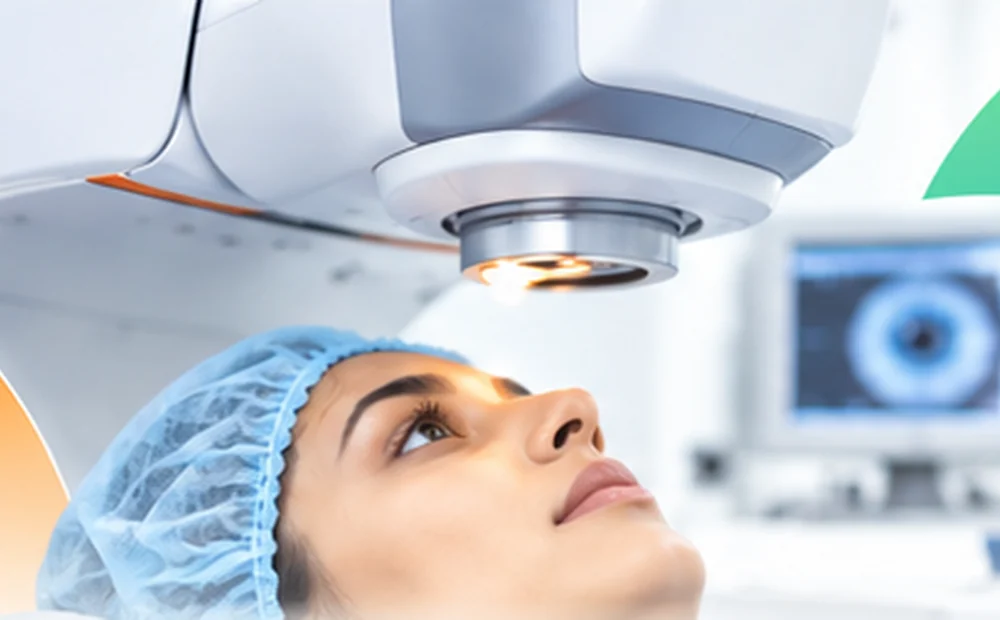
Vision correction starts with the right candidacy assessment.
At Gupta Eye Center, refractive-surgery consultations focus on whether laser vision correction or another refractive option is appropriate for your eyes, prescription and visual goals. Suitability depends on detailed measurements and overall eye health, so the decision begins with careful screening rather than a one-size-fits-all procedure.
Dr. Shyam GuptaOphthalmologist in LucknowClinical Research Fellow • Singapore National Eye CentreDr. RML Hospital / PGIMER • New Delhi
When to seek evaluation
When an eye assessment may be useful.
You are considering reducing dependence on spectacles or contact lenses.
Your spectacle/contact-lens prescription has been stable and you want to understand surgical options.
You want an assessment of corneal shape, thickness, dry eye and overall eye health before deciding.
Clinical evaluation
What may be checked during assessment.
Refraction and visual-acuity testing
Corneal topography/tomography and thickness assessment when indicated
Tear-film and dry-eye evaluation
Pupil size and full eye-health examination
Discussion of occupation, expectations, alternatives and risks
Treatment pathways
Treatment is matched to the diagnosis and the eye.
The options below are common approaches that may be discussed. The appropriate plan depends on examination findings, diagnosis, eye health and individual needs.
01
LASIK
A corneal flap is created and laser energy reshapes underlying corneal tissue. Suitability depends on corneal and general eye factors.
02
PRK / surface laser
Laser reshaping is performed on the corneal surface without a LASIK flap; recovery is different and suitability is individualized.
03
Other refractive options
Depending on age, prescription and eye health, non-laser or lens-based alternatives may be considered instead of LASIK.
Your consultation
What to expect at your consultation.
01
History & symptoms
Your vision, symptoms, previous eye care, medicines, health conditions and treatment goals are reviewed first.
02
Eye examination
Tests are selected according to the concern and may include vision testing, eye pressure, slit-lamp examination, dilation or imaging.
03
Plan & follow-up
Findings are reviewed with you, along with appropriate options, expected benefits, limitations, risks and follow-up.
Refractive Surgery FAQ
Common questions about refractive surgery.
These answers provide general guidance. Diagnosis and treatment decisions require an individual eye examination.
Most laser refractive procedures change the shape of the cornea so incoming light focuses more accurately on the retina. The amount and pattern of correction are planned from measurements of your refractive error and eye anatomy.
No. Factors such as unstable prescription, thin or irregular corneas, keratoconus, significant dry eye, certain medicines, pregnancy or other eye/health conditions can affect suitability. A detailed pre-operative examination is essential.
No procedure can guarantee permanent freedom from glasses. Some people may still need glasses for certain tasks, may have residual prescription, or may need reading glasses with age.
Possible issues include dry eye, glare, halos, night-vision symptoms, under- or over-correction, infection, inflammation and rare loss of vision. The consultation includes discussion of the risks that are relevant to the procedure being considered for you.
Expect detailed measurements, a review of your medical and eye history, and discussion of risks, benefits, alternatives and realistic expectations. Contact-lens wear may need to be paused before measurements.
Recovery differs by procedure and patient. Vision can fluctuate for weeks or months after refractive surgery, and follow-up is important to monitor healing and stability.
Patient information sources
Independent patient information.
These independent public eye-health resources provide additional general reading alongside the information discussed during consultation.